ABOUT INDIA - MEGHALAYA
We owe a lot to the Indians, who taught us how to count, without which no worthwhile
scientific discovery could have been made!" – Albert Einstein
India, a country in South Asia,
is the seventh largest by geographical area, the second-most populous country with
1.18 billion people, and the most populous democracy in the world. Mainland India
is bounded by the Indian Ocean on the south, the Arabian Sea on the west, and the
Bay of Bengal on the east. The subcontinent of India lies in South Asia, between
Pakistan, China and Nepal. It is a country of 28 states & 7 union territories with
a parliamentary system of democracy. To the north it is bordered by the World's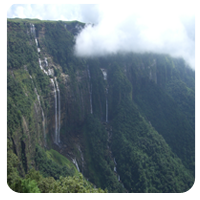 Highest Mountain Ranges – The Himalayas. Down south, plateaus, tropical rain forests
and sandy deserts are bordered by palm fringed beaches.
Highest Mountain Ranges – The Himalayas. Down south, plateaus, tropical rain forests
and sandy deserts are bordered by palm fringed beaches.
Home to the Indus Valley Civilization
and a region of historic trade routes and vast empires, the Indian subcontinent
was identified with its commercial and cultural wealth for much of its long history.
Four major religions, Hinduism, Buddhism, Jainism and Sikhism originated here, while
Zoroastrianism, Judaism, Christianity and Islam arrived in the first millennium
CE and shaped the region's diverse culture. Gradually annexed by the British East
India Company from the early eighteenth century and colonized by the United Kingdom
from the mid-nineteenth century, India became an independent nation in 1947 after
a struggle for independence that was marked by widespread non-violent resistance.
The Indian economy is the world's
eleventh largest economy by nominal GDP and the fourth largest by purchasing power
parity. Economic reforms since 1991 have transformed it into one of the fastest
growing economies in the world.India is a nuclear weapons state and has the third-largest
standing army in the world. India is considered to be a potential superpower, having
a rapidly growing economy and growing political clout. It is a member of the Commonwealth
of Nations, the South Asian Association for Regional Cooperation, G15, G20, Asia
Cooperation Dialogue, the Colombo Plan, Indian Ocean Rim Association for Regional
Cooperation and the Non-aligned movement, and is one of the BRIC Countries. A pluralistic,
multilingual and multiethnic society, India is also home to a diversity of wildlife
in a variety of protected habitats.
MEGHALAYA
The hilly state of Meghalaya is
tucked away in the hills of eastern sub-Himalayas. The state has one of the most
beautiful landscapes in India where the nature has poured in abundance the gifts
of rain and sunshine. The unending affair between smoky hills and clouds and vast
stretches of lush green forest would unfailingly capture your imagination. Ever-hospitable
colorful tribes lend it with a mystic charm. 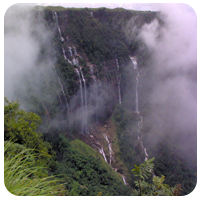 Meghalaya (Abode of Clouds in Sanskrit)
is one of the seven Northeastern states of India. It is bound by Assam in north
and east and by Bangladesh in the south. River Brahmaputra (or Luit as called locally)
forms the border in the west. It comprises of erstwhile Khasi-Jaintia hills and
Garo hills districts of Assam. Most of the terrain is hilly and experiences heavy
rainfall during monsoons. Meghalaya is home to three major tribal population - Khasis,
Garos and Jaintias.
Meghalaya (Abode of Clouds in Sanskrit)
is one of the seven Northeastern states of India. It is bound by Assam in north
and east and by Bangladesh in the south. River Brahmaputra (or Luit as called locally)
forms the border in the west. It comprises of erstwhile Khasi-Jaintia hills and
Garo hills districts of Assam. Most of the terrain is hilly and experiences heavy
rainfall during monsoons. Meghalaya is home to three major tribal population - Khasis,
Garos and Jaintias.
About one third of the state is
forested. The Meghalaya subtropical forests eco region encompasses the state; its
mountain forests are distinct from the lowland tropical forests to the north and
south. The forests of Meghalaya are notable for their biodiversity of mammals, birds,
and plants. Meghalaya, a hilly strip in eastern India, covers a total area of just
22,429 km2. It was originally part of Assam, but on 21 January 1972, the districts
of Khasi, Garo and Jaintia hills became the new state of Meghalaya. Meghalaya
is predominantly an agrarian economy. The important crops of the state are potato,
rice, maize, pineapple, banana etc. The service sector comprises of Real estate
and Insurance companies. Meghalaya's gross state domestic product for 2004 is estimated
at $1.6 billion in current prices